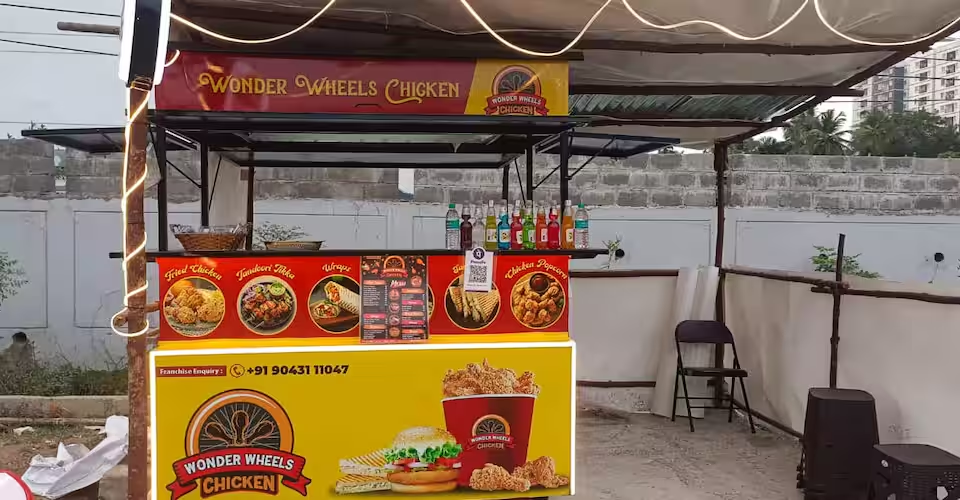
Wonder Wheels Chicken is the perfect candidate for quick service restaurant (QSR) space with its mobile/food truck idea and minimal investment. The company labels itself as a rapidly emerging fried-chicken operation that wishes to mix flexibility, low-cost setup, and great micro-location potential.
What Makes This Franchise Worth Considering?

Low-cost entry model: In contrast to numerous big burger/chicken chains that require investment of several lakhs, Wonder Wheels offers a mobile or small-footprint model starting at around ₹1.4 lakh.
Mobile/kiosk format: The brand emphasises a “wheels” or food-truck flavour which reduces the requirement for large dine-in space. This can mean lower rent, lower infrastructure cost and faster break-even.
Support & training: Franchisees receive brand setup, marketing help and food-material supply support as part of the package.
Flexible scale: From a minimal investment (100 sq ft kiosk) to larger store formats, the model allows scaling depending on budget and location.
Investment & Setup Details

According to the brand’s published information:
Minimal model: Investment “starts from ₹1.4 lakhs” (about ₹1,40,000) for the mobile/kiosk or smaller unit model.
Larger store format: For a fuller shop, the investment ranges higher (e.g., with full interior, kitchen equipment, licence etc).
Space requirement: The kiosk/food-truck model can start with just around 100 sq ft space.
Royalty & fees: The minimal model claims “no royalty fee” in some instances; larger setups may have ongoing royalty.
Setup components: Kitchen equipment, truck/van fit-out, branding, interior/exterior setup form part of the cost.
What to Expect as a Franchisee

Footfall and location matter: The success of the mobile format will be determined by the location with high foot traffic, such as those near colleges, markets, and public transport hubs.
Operational speed: The fried-chicken/finger-food segment operates in the quick-service, high turnover, and take-away/delivery model, which is suitable for fast-service, high turnover, and take-away/delivery operations.
Marketing and positioning: Menu innovation (special wings, spicy variants), branding, and social media are some of the methods that can help in competing markets.
Logistics and supply: Quality control of the fried-chicken across the outlets is the most important thing—freshness, supply chain, and hygiene are critical.
ROI timeline: Even if the initial investment is small, the inventory, the rent (for stand/truck), the wages for the staff, and the presence of competitors in the area will all affect when the business will break-even. Franchise support is beneficial.
Pros & Potential Challenges

Pros
Very affordable entry compared to full-scale restaurants
Flexible mobile/outlet model adaptable to semi-urban or urban locations
Support from brand in training, supply and marketing
Challenges
Even with low cost, site selection is critical—poor location will hurt sales.
Supply chain and perishables management demand strong operational discipline.
Strong competition in fried-chicken/QSR segment; differentiation will matter
Mobile/truck models may face regulatory/licence hurdles (local permits, health licences)
Extra Content — How to Maximise Success
Choose the right footprint: If investing the minimal model, ensure you’re in a high-walk-by zone (e.g., near transit stops, school/college clusters).
Leverage delivery/online channels: Tie-ups with food-delivery apps will boost sales especially for take-away wings/snacks.
Menu innovation: Offer signature flavours (local spice levels, veggie-friendly options) to build loyalty.
Local marketing: Use social media, local tie-ins (events, college fests) to create brand recall for “wheels” concept.
Keep cost control tight: Monitor raw-material, wastage, equipment maintenance—fried-food margin can erode quickly if costs run high.



Leave a Reply