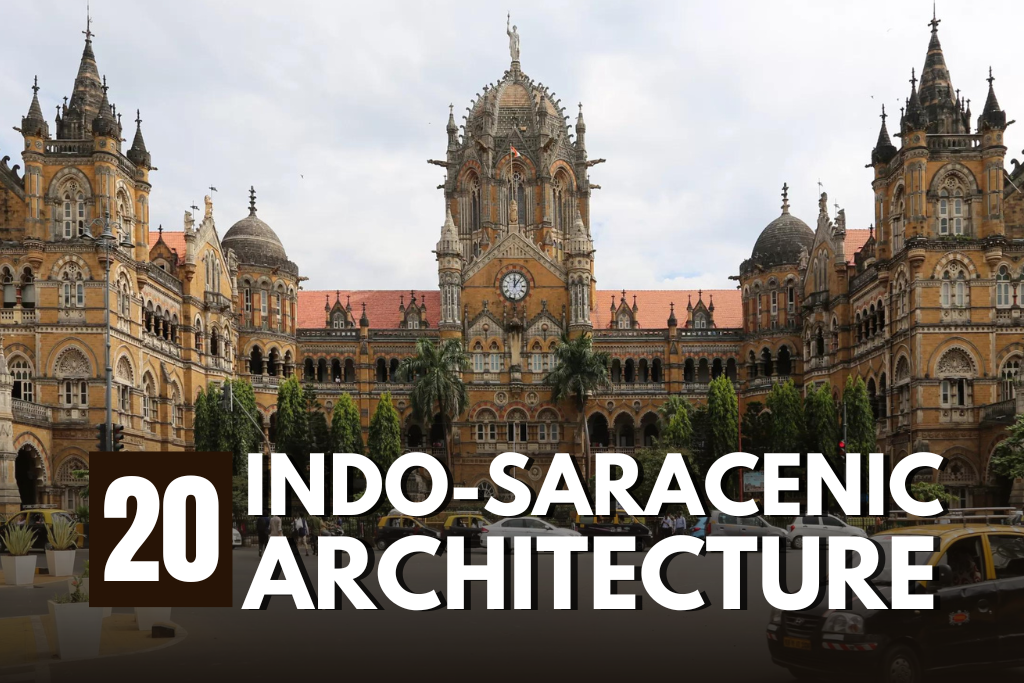
Indo-Saracenic architecture is undoubtedly one of the most notable architectural movements that came to light during the British Empire in India. This architectural style flourished mostly in the 19th century and represented a remarkable mixture of Indian, Islamic, and even European architectural trends, with Gothic Revival, Neo-Classical, and Victorian influences being among them. It became significantly associated with public buildings like almighty railway stations, courts, universities, palaces, and museums, thus forming the visual identity of the colonial period in India.
The word Saracenic comes from the medieval Latin term Saracenus, which was mainly used as a synonymous expression for Arab Muslims. In architectural terms, it simply refers to the elements that were inspired by the Islamic forms, particularly the Mughal and local Indian styles.
Historical Development of the Style

Early Experiments
The design of Indo-Saracenic architecture was roughly sketched out in the late 18th century when architects from Europe were experimenting with Western construction methods as per the local climate and culture in India.
Colonial Vision and Mughal Influence
The decline of Mughal political power also meant that British administrators were looking for an architectural language that would be both the dominant and culturally assimilating one. The result was the conscious merging of Mughal motifs like domes and arches with Western planning concepts.
Role of British Architects
Robert Fellowes Chisholm, Henry Irwin, and Samuel Swinton Jacob were the main architects who contributed greatly to making the style official. Their projects in Madras, Bombay, Calcutta, and the princely states gave Indo-Saracenic architecture a distinct personality.
Peak and Decline

The Raj period saw the full flowering of the style, but its decline began soon after, when modernist and regional architectural modes of expression replaced it with India’s gaining independence in 1947. Presently, a lot of Indo-Saracenic constructions are being preserved as heritage buildings.
Main Architectural Characteristics
Indo-Saracenic constructions are valued for their visual extravagance and symbolic representation. Some of the features that are typical of this style are:
High onion-shaped domes and chhatris
Pointed arches and colonaded verandahs
Very intricate jali screens and stone carvings
Courtyards suitable for hot climates
A combination of local and modern materials in the process of construction
The result of these elements was the creation of buildings that were both monolithic in size and user-friendly in terms of climate.
Landmark Illustrations All Over India
India is full of one-of-a-kind Indo-Saracenic structures that not only reflect the adaptation of the style in different regions but also the different Indian states’ culture, religion, and life:
Chhatrapati Shivaji Terminus, Mumbai –

A UNESCO World Heritage Site that mixes Victorian Gothic with Indian ornamentation
Victoria Memorial, Kolkata –

A huge white marble monument that is a mixture of Mughal symmetry and European classicism
Rashtrapati Bhavan, New Delhi –

The terrific fusion of Mughal, Rajput, and Western architecture
Gateway of India, Mumbai –

The ceremonial arch that signifies the global ties of colonial India
Madras High Court & Senate House, Chennai –

The best examples of South Indian Indo-Saracenic architecture
Mysore Palace –

The most luxurious mixture of Hindu, Islamic, and Gothic styles
Falaknuma Palace & Salar Jung Museum, Hyderabad –

Exhibiting Indian, Persian, and European luxury
Albert Hall Museum, Jaipur, and Baroda Museum, Vadodara –

The cultural establishments that mirror princely patronage
Railway stations such as Jodhpur Railway Station and civic monuments like Vidhana Soudha, Bengaluru, are other examples that prove the versatile nature of this architectural style.
Cultural Importance and Legacy
Indo-Saracenic architecture represents more than colonial aesthetics—it reflects a dialogue between cultures. By integrating Indian craftsmanship with European planning, these buildings created a shared architectural language that still defines many Indian cities today.



Leave a Reply