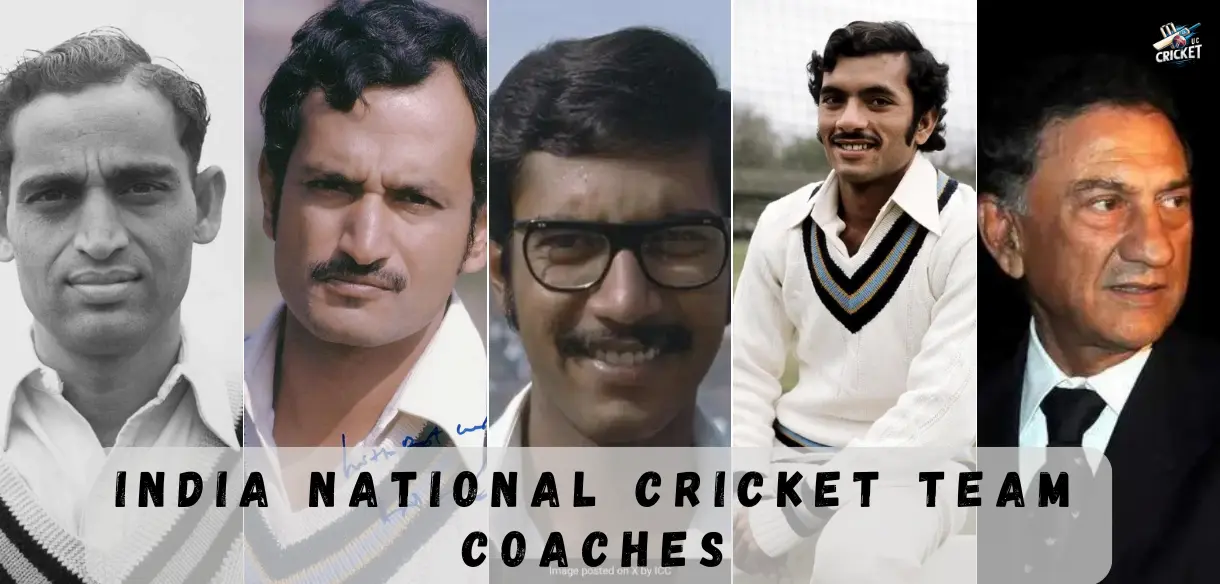

Cricket enjoys a deep, emotional connection in India and is seen as an activity that unites the person from every walk of life. While the fame-hunters and media keep a spotlight on the players, the coaches allied in the shadows deserve far more credit in the team’s actual success. A long list of coaches headed the Indian cricket team since 1971, each with different strategies and philosophies, contributing far and wide toward the evolution or achievements of the team.
The coaching calendar begins with Keki Tarapore, who, for a short while, was at the helm during India’s historic 1971 tour of England. Hemu Adhikari, from 1971 to 1974, instilled discipline and physical fitness while molding future legends like Sunil Gavaskar. Gulabrai Ramchand’s reign during the 1975 World Cup saw him try to get India oriented to the new one-day format, albeit with little success.

In the late ’70s and early ’80s, Datta Gaekwad, Salim Durrani (with an emphasis on aggressive batting), and Ashok Mankad were molding the team and fine-tuning strategies. PR Man Singh, who was the team manager between 1983 and 1987, was a key figure behind India’s historic 1983 World Cup triumph. In 1988, 1990–91, and 1991–92, respectively, Chandu Borde, Bishan Singh Bedi, and Abbas Ali Baig brought different variants and foci into the coaching styles emphasizing cooperation, spin bowling, and technical development.
The mid-90s saw coaches like Ajit Wadekar, Sandeep Patil, Madan Lal, and Anshuman Gaekwad, who focused on boosting player morale, skill-building, and providing young talents a platform. Kapil Dev returned in 1999 to impart a sense of aggression but resigned amidst controversial allegations that were later thrown out.
The modern era of Indian coaching began with John Wright (2000–2005), the first foreign coach of India, who brought professionalism to the team and laid the foundation for its major wins overseas. Greg Chappell (2005–2007) followed with a rather controversial stint marked by experiments and internal discord. Lalchand Rajput moved the team into the shortest format after leading it to victory in the first T20 World Cup in 2007.
The Indian team, under Gary Kirsten (2008–2011), won the 2011 World Cup and achieved ranking as the top Test nation, due to his intense focus on individuals. Duncan Fletcher (2011–2015) focused on fitness and technique, which enabled winning the 2013 Champions Trophy. Anil Kumble (2016–2017) further developed the team’s bowling resources with a special emphasis on home conditions, while Ravi Shastri (2017–2021) presided over great Test wins in Australia.

Rahul Dravid (2021–2024) found himself engrossed in the task of nurturing young talents and led India to a T20 World Cup title in 2024. Gautam Gambhir then, from 2024, started imparting intensity into the group and installing a team-first mentality as India remained unbeaten in 2025 through the Champions Trophy. These coaches have passed down the 2025 decade of determination, strategy, and leadership in India`s cricketing history.



Leave a Reply