
Badminton being a dynamic sport and one of strategizing needs a well-defined playing area. For all intents and purposes, whether the tandem engages in the sport for amusement or professionally, a clear comprehension of how big a badminton field is can yet greatly influence his or her performance and strategy.
Standard Dimensions of a Badminton Court

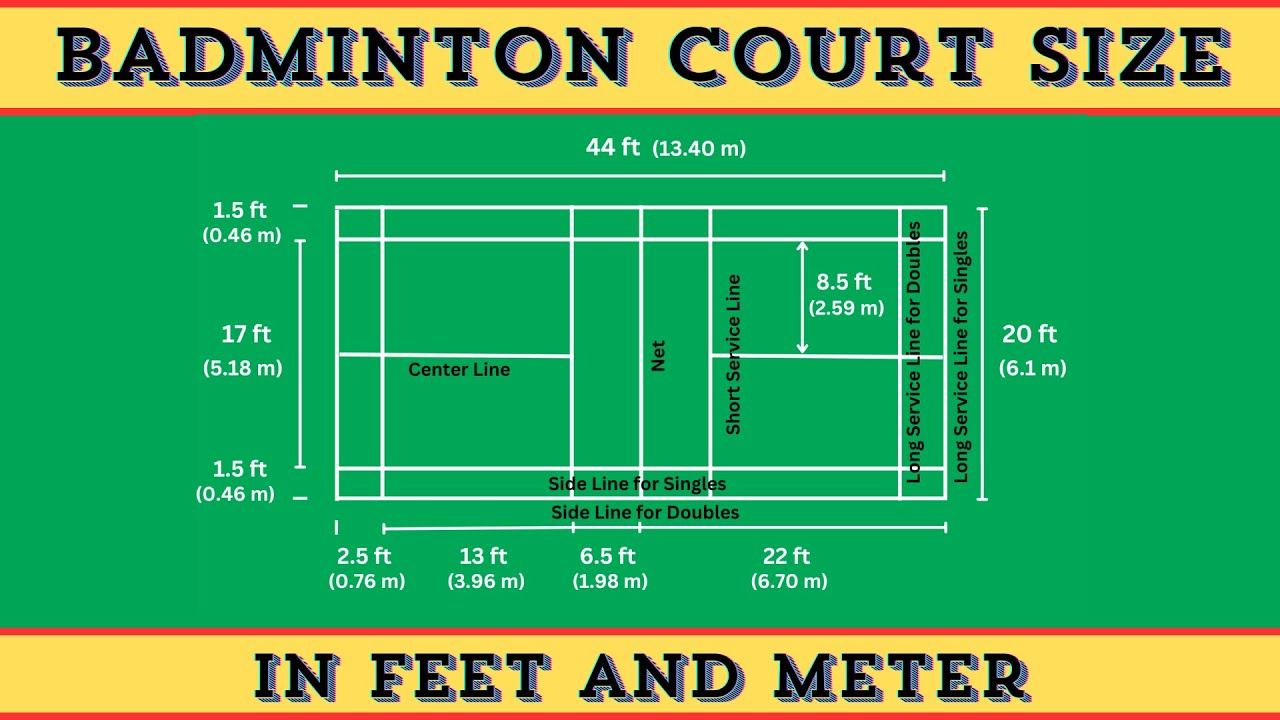
A badminton court is exactly 44 feet (13.4 meters) long for singles as well as doubles matches. Depending on the nature of the match, the width differs:
Double Court: 20 feet (6.1 m) in width
Single Court: 17 feet (5.18 m) in width
This standard stays constant throughout professional and amateur settings to maintain fairness and uniformity within the sport.
Areas of the Court

A badminton court, with its particular zones, consists of bordering lines:
Baseline: The farthest stretch of the court.
Service line: A line closer to the net than a baseline that marks the farthest limit for serves.
Centre line: Cuts across the service courts.
Side lines: Mark the boundaries for singles and doubles.
The lines mark of such areas to govern the game with their assistance being relied on for deciding proper service and gameplay.
Net Specifications

The net divides the court into two equal halves and is crucial to gameplay. According to international standards:
The net height is 5 feet (1.524 meters) at the center
It rises slightly to 5 feet 1 inch (1.55 meters) at the edges
The net width spans the court’s full width (20 feet)
The net must be tightly secured and leveled to avoid sagging, which could disrupt play.
Vertical and Surrounding Space Requirements
Minimum height of 9 meters is recommended for the ceiling to provide plenty of room for high shots and smashes, but professional courts may have 12 meters in height.
There should also be at least 4 feet of clearance on all sides of the court. This space around the court enables players to move freely and safe guards against the risk of injury or collision.
Surface Materials and Line Markings

A badminton court may be made of one of the following materials:
Wood: Provides a natural bounce, best for indoor courts.
Synthetic flooring (PVC or rubber): It is durable and has good gripping qualities.
Usually, court lines are white or yellow to ensure their visibility, with a width of about 40mm. Contrast from the floor color of the area is, therefore, extremely essential to allow players and viewers to observe the line clearly.
International Standards
The Badminton World Federation (BWF) establish the official court specifications and rules which are equally held irrespective of whether it is at the local club or an international tournament.
Conclusion
The size of a badminton court, being 44 ft long and up to 20 ft wide, essentially decides the pace of the game and the style of players. Knowing the dimensions can help a player better implement his tactics, understand how a court is set up, and enhance his playing experience. Whether you want to build your own court or play professionally, these dimensions are a must for the soul of the game.




Leave a Reply