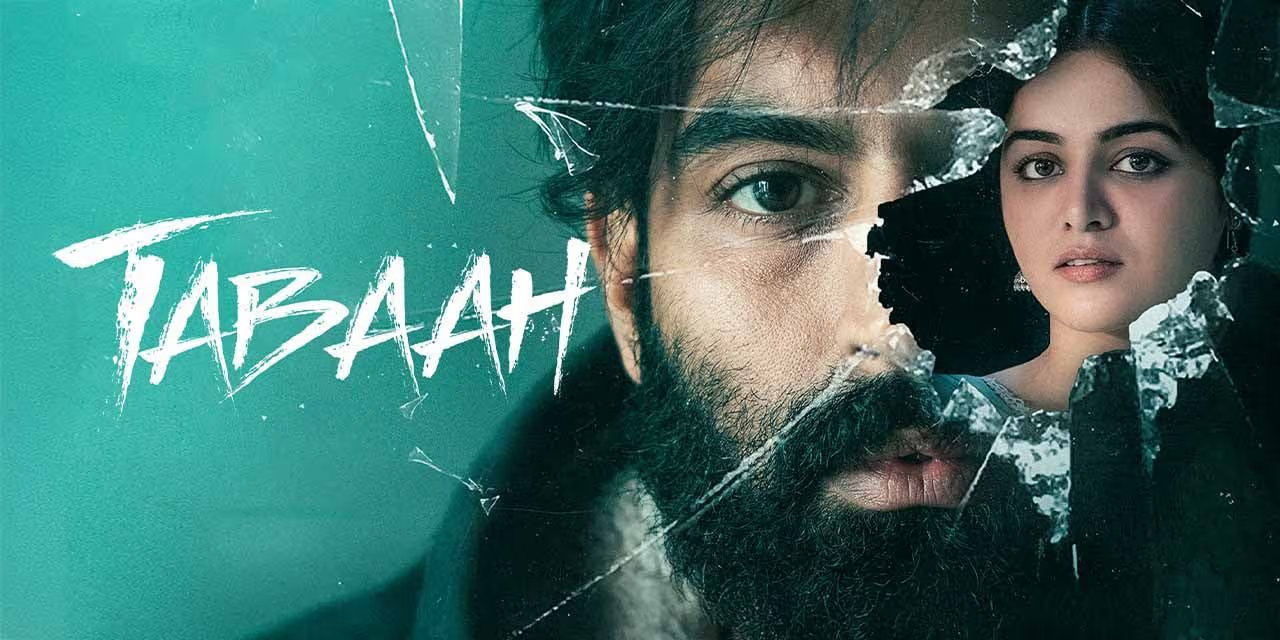

In Tabaah, director and performer Parmish Verma spins a tragic but tender story of love that isn’t spoken, wounds that won’t heal, and a life that is worn away by the passage of time. This Punjabi-language film is an understated, emotionally honest romance that avoids the loud dramatics of a genre it inhabits in favor of quietly devastating. And it is in this respect that it gives one of the year’s most reflective considerations of lost love.
Amber, played by Verma, is not your conventional tragic lover. Once a bright university student with a promising future, his brilliance dims under the weight of his unexpressed love for Raavi, portrayed by the ever-charming Wamiqa Gabbi. As years pass and life takes its toll, Amber turns to alcohol and self-destruction—not because society forbids his love, but because of his own inability to express it.

The real strength of Tabaah lies in its minimalism. There are no parental villains, no violent class divides, and no melodramatic revelations. Rather, the film examines the simple and essential fact that there can be some of the greatest tragedies born from silence. The understated approach is effective in allowing the characters to breathe and the full weight of their emotions to settle within the quiet.
Performances that Speak Through Silence
Parmish Verma gives a deeply internalized performance as Amber. He captures the fragility of someone slowly collapsing under emotional repression. His portrayal is not showy—it’s vulnerable, wounded, and consistently restrained. Wamiqa Gabbi is as graceful as Raavi. Her limited screen time does not reduce her impact; her presence lingers even in her absence, which mirrors how Amber experiences her in his memories.
Supporting actors Dheeraj Kumar and Kavi Singh, as Amber’s loyal friends, bring warmth and grounded realism. Kanwaljit Singh, portraying Amber’s father, adds subtle emotional heft, his quiet support contrasting with his son’s inner turmoil.
Direction, Screenplay & Cinematography
The film Tabaah directed by Parmish Verma, and written by Gurjind Maan, has the advantage of a straightforward and concise screenplay. There are no plot tangents. The story is genuine and linear, almost like a heartfelt letter written with the intent to never send it.
The film is visually beautiful. Cinematographer Ishan Sharma uses incredible close-ups, dark, shadowy interiors, and washed-out colors to connect us to Amber’s mental state. The transition from the past to the present is fluid and allows us to smoothly slip into the character’s memories without disorientation.
That said, the film’s deliberate pacing may frustrate some viewers. Some scenes feel remarkably stretched, meant to communicate the protagonist’s unmistakable inner stillness and emotional paralysis—they sometimes nearly risk becoming so slow they feel bored.
Emotional Texture and Music
The soundtrack is haunting and soulful. It doesn’t try to dominate the movie, it quietly supports the characters’ responses and emotions they cannot express. Dreadful ballads and lightly used background sounds make the imagery permanently sad.
Some might find the repetitive tone of the music a bit overbearing for the second half, but once again all the music is very successful in achieving thematic unity.
Cast and Crew
Parmish Verma – Director, Producer, Lead Actor
Wamiqa Gabbi – Female Lead (Raavi)
Dheeraj Kumar and Kavi Singh – Supporting Roles
Kanwaljit Singh – Amber’s Father
Gurjind Maan – Screenplay Writer
Ishan Sharma – Cinematographer
Music Team – A blend of traditional Punjabi soul and modern melancholy

Final Verdict
Tabaah isn’t a film for everyone. It doesn’t entertain in the conventional sense; it aches, lingers, and slowly unfolds like a wound we keep reopening. But for those who appreciate emotionally nuanced cinema rooted in realism, Tabaah is a rewarding watch.
By choosing not to dramatize but to humanize heartbreak, Parmish Verma delivers his most mature performance and film to date. Tabaah is not just a love story—it’s a portrait of emotional paralysis, one that stays with you long after the credits roll.




Leave a Reply