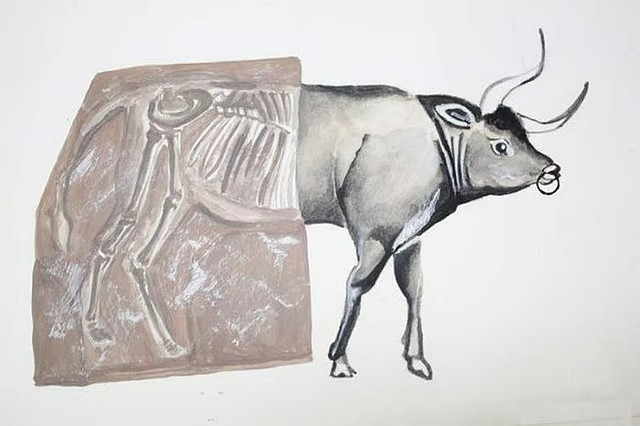

India has a great diversity of wildlife, forests, rivers, and mountains, which in the past had thousands of unique animals. But over the years, many species died out due to hunting, habitat destruction, climate change, and human actions. These extinct animals serve not only as history but also as a warning of what happens when we don’t protect the natural environment for our children.
Let’s look at eight fantastic extinct animals of India, which we present in detailed accounts that paint a picture from the past.
- Indian Cheetah

The Indian Cheetah was a magnificent predator of the Indian grasslands and forests. It is known to have had great speed, which outdid that of all other land animals. Also, it’s the case that Mughal rulers at some point used to keep cheetahs for hunting, which they did because of the breed’s agility and sharp eyes.
Sadly, there was overhunting and grassland shrinkage, which led to the Indian cheetah’s extinction. In the middle of the 20th century, we see the last reports of Indian cheetahs. Today, the species is a rare sight in certain areas of Africa and Iran.
2. The Pink-Headed Duck

In India, there was a very mysterious bird, which was the Pink-Headed Duck. This beautiful bird had a black body, which, in contrast to its soft pink head and neck, stood out in the wetlands.
In the wetlands, which included riverbanks in eastern India, that was where this bird’s habitat was. As wetlands decreased and hunting rose, reports of sightings became few. By the 1980’s, the bird was reported to be extinct, but there are still reports of it out there.
3. Himalayan Quail pigeon

In the grassy hills of Uttarakhand lived the Himalayan Quail, which was a small and very colorful bird. It had remarkable feather patterns, which allowed it to blend in with the mountain vegetation.
The bird has seen to die out due to habitat loss, which was extensive, and at the hands of hunters during the colonial time. Although at times searched out by conservationists, no confirmed reports of the bird have come in for over a hundred years.
4. The Javan Tiger

Although mostly known in Indonesia, the Javan Tiger also plays a role in talks that extend to extinct Asian wildlife that the greater Indian subcontinent ecosystem once supported. It was a smaller version of the Bengal tiger but very powerful and graceful.
Deforestation and human development have put this tiger on the path to extinction. We see in the decline of top predators like this tiger, the fragility of ecosystems, which in turn alerts us.
5. Sumatran Rhinoceros
A long time ago, the Sumatran Rhinoceros was found in the forests of North East India. It had thick hair and also two horns; it looked very different from the Indian one-horned rhino we see today.
Poaching and habitat loss led to its extinction in India. This gentle giant is now at critical risk worldwide.
6. Woolly Mammoth

The Woolly Mammoth is a very well-known extinct animal. The fossil record reports that related species of these large animals once lived in areas that at the time were connected to what is today the Indian subcontinent in prehistoric times.
With dense fur and large curved tusks, mammoths were a fit for cold climates. Also, due to climate change and human hunting, they went out of existence thousands of years ago.
7. Sivatherium

Sivatherium was a prehistoric animal which is a mix of a giraffe and a deer. In India, we have fossil records that show it to have lived in grasslands and forests.
Its great size, thick legs, and impressive horn-like appendages made it one of the most atypical ancient mammals. Environmental changes may have played a role in its extinction.
8. Indian aurochs

In India, the Aurochs was a large wild cattle that is thought to be the parent stock of today’s domestic cows. It had very large horns, a very muscular body, and great strength.
Over time, which saw the result of overhunting and domestication was that wild populations diminished until they disappeared totally. Today, what remains of them is in the various cattle breeds we see worldwide.
Conclusion
Extinct Indian fauna present us with powerful tales of nature’s balance and struggle for survival. Each species had a key role to play in its ecosystem. Their extinction also marks that conservation is a wide range issue which includes the protection of forests, rivers, and the environment as a whole.
Through our beautiful illustrations and stories, we see back to the great biodiversity that once was in India, and we also realize the present urgency of conservation of endangered species.
About the Author


