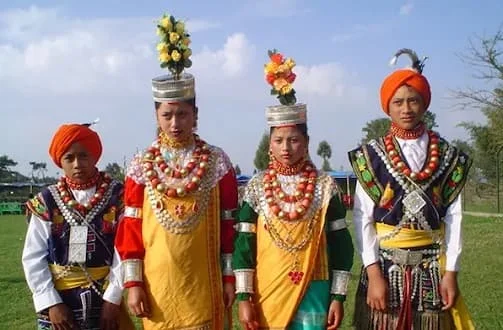

People of each tribe have their own distinct clothing as influenced by the climate of the area, customs, and way of life.

In Meghalaya, the traditional attire for men, especially among the tribes, hardly differs a lot, being characterized by a sleeveless coat or tunic over the shirt or sometimes over his bare torso, while the lower attire traditionally consists of fabric akin to a dhoti-type being wrapped around the waist and reaching the knee or below. The men of Khasi and Jaintia usually wear a sort of sarong called a Jymphong with a jacket and they may decorate their attire with a turban or an ornamental headpiece made with feathers and beads for rituals. For men, the wrap-around garment called Dakmanda, a heavily decorated one, is generally worn by the Garos along with a sleeveless tunic. The traditional weapons are sometimes carried to enhance the attire of men during celebrations and dances.
Traditional garments for women here have been the most colorful and elaborately layered ones in India. The long dresses of the Khasi women, the Jainsem, consist of two large pieces of fabric wrapped around the body, layered in style, and fastened at the shoulders to cover the body from shoulders to ankles. Special occasions saw the wearing of ornaments made of gold or silver, in addition to a tap-moh klieh (silk scarf or head wrap). The form of dress for Jaintia women corresponds fairly closely to that of their Khasi counterparts but is adorned and put into highlights of hand-woven textiles.
The traditional dress for Garo women comprises garments fastened at the waist, called Dakmanda, which reach the knees.
The tribal dresses of Meghalaya fiercely reflect tribal pride and identity; each piece of clothing expresses a story about the people’s relationship with nature, society, and heritage.



Leave a Reply